Where Did Taekwondo Originate? History and Origins Explained
Headbutts: when you go up to a random person and ask, “Where is Taekwondo from?” The reply is normally a hasty “Korea.” But is it really that simple? Not quite. Taekwondo is a tale of the old warfare, forbidden powers, and a national identity erased nearly off the map.
Nowadays, it is an Olympic sport that is practiced by millions all over the world, yet in the history of the Three Kingdoms, it was a bloody battlefield where your only hope of survival was your hands and your feet.
The Short Answer: Where Does Taekwondo Come From?
The official answer is that Taekwondo is from South Korea. It was formally unified and named in the 1950s, but its “soul” dates back thousands of years, drawing on indigenous Korean combat styles like Taekkyon and Subak.
The Modern Name: Officially Coined in 1955
One of the best-kept secrets of martial arts is that the name “Taekwondo” did not exist until April 11, 1955. Before this date, Korea was saturated with a range of martial arts schools (kwans) that taught different styles.
The man in charge was General Choi Hong Hee, also known as the Father of Taekwondo, who insisted on a common name to enable the Korean people to have some sense of national pride following a decade of war. Tae (to strike with the foot), Kwon (to strike with the fist), and Do (the way or the path) are the choices he made.
Pro-Tip: If you see a school claiming their “Taekwondo” style is 2,000 years old, they are referring to the lineage, not the name itself!
The Hwarang: Taekwondo’s Ancient Roots in Silla
The Hwarang were well known long before the black belts and tournaments. They were the high-level youth warriors of the Silla Dynasty (57 B.C. – 935 A.D.). They were not soldiers, but poets, scholars, and martial artists who trained in the mountains and rivers.
The Hwarang were very ethical: they believed in being loyal to the country, fighting bravely, and never retreating. Modern Taekwondo emphasizes the “Indomitable Spirit” due to its influence. You watch a practitioner prostrate himself before you get on the mat, and you are looking into a 1,500-year-old tradition of the Hwarang warriors.
The Japanese Occupation Era and Karate’s Influence
This is the “Dark Secret” most history books gloss over. From 1910 to 1945, Japan occupied Korea and banned all indigenous Korean martial arts. Practicing taekwondo could land you in prison.
To keep their culture alive, many Koreans practiced in secret or traveled to Japan and China to learn karate and kung fu. When Korea was finally liberated, these masters returned and blended their ancient Korean kicking techniques with the linear hand strikes of karate. This unique “hybrid” DNA is what makes Taekwondo so versatile today.
The Sine Wave: Taekwondo’s Signature Movement
What makes Taekwondo kicks so much stronger than other forms? The secret lies in kinetics. Contrary to most forms of arts where muscle tension is involved, classic Taekwondo incorporates a Sine Wave motion: a slight up-and-down motion of the body.
When you free up the body and fall upon the impact of the strike, you use the force of gravity to multiply your impact. That is the way a 120-pound professional can produce enough force as to bend a three-inch-thick piece of wood in two. It is not power alone, but motion in the physique.
Common Mistake to Avoid:
Many beginners try to “muscle” their kicks by tensing up. In Taekwondo, tension is the enemy of speed. The more relaxed you are, the faster your leg travels, and the harder the impact will be.
From Battlefield Skill to Olympic Sport
Modern Taekwondo employs electronic chest protectors, helmets, and points. But its ancestor, Subak, was even more barbarous. During the Goryeo Dynasty, the Subak matches were commonly used to resolve conflicts or to examine soldiers to promote them.
The ancient documents indicate that these competitions used to be characterized by headbutts, blows to the throat, and joint dislocation, which today are highly illegal in the Olympics. Although we now rejoice in the safety of the sport. We must keep in mind that these motions were first formulated to be the means of saving life or death on the battlefield.
The Global Explosion: From Korea to the Olympics
The journey of Taekwondo from small Korean villages to the Olympic stage is a miracle of cultural branding. After the Korean War, masters were sent all over the world to demonstrate the art.
It made its debut as a demonstration sport at the 1988 Seoul Olympics and became a full medal sport in Sydney 2000. Today, it is practiced in over 200 countries, proving that it started in Korea. It now belongs to the world.
Why Taekwondo Matters in 2026
Taekwondo provides a unique blend of bodily and human strength in a screen-dominated world where people live sedentary lives. Learning how not to fight is not only about that.
What Most People Get Wrong About the Black Belt
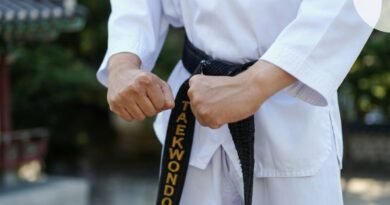
The greatest myth is that a black belt is the culmination of the process. In Korean culture, a 1st-degree black belt is referred to as “Cho Dan,” which translates to “beginner.” It means that the student is now ready to start the actual study of the art since he has already learned the basics.
“A black belt is just a white belt that never gave up.”
Final Thoughts: The Spirit of the Foot and Fist
So, where is Taekwondo from? It comes out of the hard-mouthed mountains of Korea. The covert training schools of the Japanese occupation and the hard minds of the Hwarang warriors.
Be it a way to lose weight, a defense, or a way to bring peace to the mind. Taekwondo has offered a path that has been traveled by millions over several centuries. It is not just a sport but a statement of how the human spirit can live and even exist.