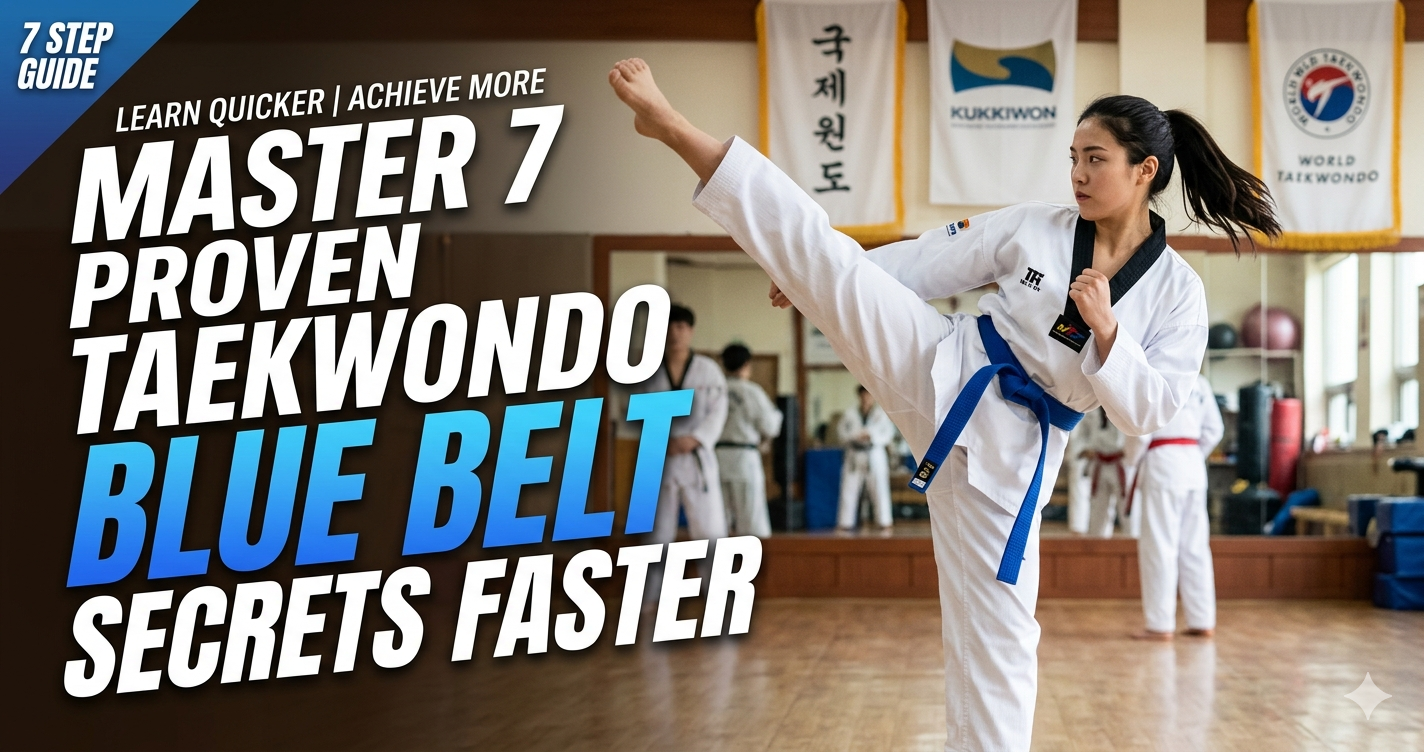
Master 7 Proven Taekwondo Blue Belt Secrets Faster
What Separates Blue Belts Who Thrive From Those Who Quit?
You’ve survived the beginner chaos of the white belt stage. You pushed through the fundamentals of the green belt. And now, standing at the threshold of the Taekwondo blue belt, something feels different. Harder. More demanding. Like the dojang itself expects more from you.
Here’s the uncomfortable truth: most practitioners stall at blue belt—not because of physical limitations, but because of mental and technical blind spots nobody warned them about.
Switching to a blue belt in taekwondo is more than just a change of color. Here is where the recreational interest becomes real martial discipline. Many master instructors say this is the rank where up to 40% of students stall or drop out altogether. Expectations rise exponentially, techniques become more intricate, and the sparring sessions suddenly feel like there is something real on the line.
But it does not have to be like hitting a wall. The common thread among practitioners who have sped through the blue belt rank is that they trained smarter, not just harder. Here are 7 field-tested secrets that will help you sail this rank with precision and confidence.
1. Stop Practicing Techniques — Start Drilling Patterns
The biggest mistake blue belt students make? They confuse repetition with practice. Throwing 100 roundhouse kicks in a row feels productive. It rarely is.
Real drilling is taking a technique and breaking it into micro-segments—the chamber, the pivot, the follow-through—and isolating each. It’s like a musician running through scales before a show. You don’t play the whole song until you’ve got all the notes clean.
Focus on Your Dominant and Non-Dominant Sides Equally
Most students unconsciously favor their stronger leg or hand. By blue belt, this imbalance has become a liability. Instructors notice. Sparring partners exploit it.
Spend at least 30% of your technique time on your weaker side. It will feel awkward for weeks. That discomfort is the adaptation happening in real time.
Pro Tip: Record yourself drilling on both sides. Side-by-side video comparison reveals asymmetries that mirrors and instructors can miss in a busy class setting.
Common Mistake to Avoid: Drilling fast before you drill clean. Speed is a byproduct of precision, not the other way around. A sloppy fast kick is twice as useless as a slow, correct one.
2. Reframe How You Approach Sparring
Sparring at the blue belt level is where many students emotionally unravel. Suddenly, the people you’re matched against are faster, heavier, or more experienced. The temptation is to fight harder. The smarter move is to fight differently.
Blue belts who accelerate focus on reading, not reacting. Before your opponent throws a technique, there’s always a tell—a shoulder dip, a weight shift, a glance. Learning to see these micro-cues is what separates reactive fighters from anticipatory ones.
Build a Sparring Journal
After every session, write down three things: one technique that worked, one that failed, and one thing you noticed about a training partner’s style. Do this for 30 days. The pattern recognition that develops is remarkable.
Control Distance Like Your Belt Depends On It (It Does)
Distance management is the invisible skill of taekwondo. From White Belt through Green Belt, you mostly close the distance and attack. At blue belt, you learn that controlling distance—staying just outside your opponent’s range while inside yours—is where the real game is played.
Pro Tip: Pick one sparring partner each week and focus exclusively on footwork — no attacks, just movement. Your instructor may think you’re warming up. You’re actually doing the most advanced training in the room.
Common Mistake to Avoid: Confusing aggression with effectiveness. Charging forward constantly telegraphs your intent and burns energy. Blue belt sparring rewards patience more than power.
3. Master the Mental Game — Your Body Follows Your Mind
Physical technique only carries you so far. At blue belt, the psychological weight of expectations gets heavy fast. Doubt creeps in during the forms. Frustration spikes after a bad sparring round. The students who push through aren’t inherently mentally tougher — they’ve built specific habits.
Visualization is not mysticism. Olympic-level martial artists use it systematically. Spend five minutes before each class mentally rehearsing your forms from start to finish. See your stances, feel the transitions, and hear your kihap. When your body arrives at the dojang, it’s already had one run-through.
Handle Pressure Testing Without Freezing
Belt tests are high-stakes moments that expose every gap in your training. Blue belt examinations often include surprise elements — unannounced sparring combinations, form recall under fatigue, or judging panels watching your every stance.
Pro Tip: Simulate pressure deliberately. Ask a training partner to quiz you on random techniques while you’re tired. Practice your forms in front of non-martial arts family members. Performing under unfamiliar eyes builds the composure that belt tests demand.
Common Mistake to Avoid: Over-preparing the techniques you already do well. Comfort zones feel productive, but they’re just a waste of time. Attack your weaknesses first, every single session.
4. Poomsae Is Not a Formality — Treat It Like a Fight
Too many blue belt students treat poomsae (forms) as the boring warm-up before the exciting stuff. This is a costly misread.
Each form encodes real combat sequences. The slow-looking block is a joint lock. The stepping punch is a follow-up after a takedown. When you understand the application—called “bunhae”—the form stops feeling like choreography and starts feeling like a tactical map.
Three Ways to Deepen Your Poomsae Work
- Slow motion runs: Execute the entire form at 20% speed, pausing at every transition to check your balance and hip alignment.
- Partner application drills: Break out three-move sequences from your form and practice them with a partner as actual self-defense exchanges.
- Eyes-closed practice: Once you know the pattern, close your eyes. Spatial awareness and balance gaps become impossible to hide.
Pro Tip: Ask your instructor to explain the bunhae of at least one sequence per form. Most will light up at the question—it signals you’re thinking beyond the surface.
5. Build a Recovery Practice That Matches Your Training Intensity
Here’s something nobody tells you at white or green belt: blue-belt training volume can break your body if recovery isn’t intentional. Longer sessions, more complex techniques, and increased sparring frequency create cumulative stress on joints, tendons, and the nervous system.
Stretching after class is not recovery. It’s a starting point.
True recovery for martial artists includes sleep quality, hydration with electrolytes, targeted mobility work for hips and ankles, and managing training load week to week. The students who stay injury-free long enough to reach the next rank aren’t lucky. They’re deliberate.
Common Mistake to Avoid: Training through sharp joint pain in the name of toughness. Dull muscle soreness is normal. Sharp, localized joint pain is your body filing a formal complaint. Listen to it before it escalates.
6. Learn to Lose Rounds on Purpose
This sounds counterintuitive. It isn’t.
At blue belt, ego becomes your most dangerous training partner. Students who only spar to win start avoiding harder opponents, sticking to safe techniques, and subconsciously shrinking their own development. The dojang stops being a laboratory and starts being a performance stage.
Deliberately putting yourself in bad positions during controlled sparring rounds accelerates growth faster than winning every exchange. Ask a senior belt to start every round with a positional advantage over you. Let them back you into corners. Force yourself to escape, adapt, and problem-solve under pressure.
This is how blue belts develop what instructors call fighting instinct — the ability to operate when comfort is completely gone.
Rotate Your Sparring Partners Intentionally
Most students drift toward familiar partners. Same size, same style, same predictable exchanges. Break that pattern aggressively.
- Spar with someone significantly taller at least once a week—distance management becomes a survival skill overnight.
- Spar someone faster than you and commit to not matching their pace. Work timing instead.
- Spar someone heavier and focus exclusively on angles and footwork, not power trades.
Each pairing teaches your nervous system something a drill never can: real-time adaptation.
Pro Tip: After a round where you got dominated, resist the urge to immediately ask, “What did I do wrong?” Instead, ask, “What was working for them?” Studying the opponent’s effectiveness is often more instructive than cataloguing your own errors.
Common Mistake to Avoid: Using free sparring as a chance to show off your best techniques. Blue belt sparring should feel like an experiment, not a highlight reel. Save the showcase for belt testing.
7. Find One Mentor — and Actually Use Them
Taekwondo has a quiet culture of mentorship that most students never tap into. There’s almost always a senior student—a high red belt or junior black belt—who genuinely enjoys helping motivated practitioners. The blue belts who progress fastest are rarely the most naturally gifted. They’re the ones who found that person and showed up with specific, thoughtful questions.
Notice the word “specific.” Vague questions get vague answers.
Don’t ask, “Can you watch my sparring and tell me what you think?” Ask instead, “I’m losing distance control whenever someone fakes a jab—can you drill that scenario with me for ten minutes?”
The difference in what you receive back is enormous.
What Good Mentorship at Blue Belt Actually Looks Like
It’s not long lectures after class. It’s small, targeted moments of feedback woven into regular training:
- A senior belt correcting your chamber position mid-drill
- Five minutes of focused pad work on your weakest combination
- A post-sparring debrief where someone who knows your tendencies points out one pattern you can’t see yourself in
These micro-interactions compound. Over weeks and months, they reshape technique in ways that solo drilling simply cannot replicate.
Pro Tip: Offer something in return. Help junior white belt or green belt students with basics. Teaching reinforces your own understanding at a neurological level—and it builds the kind of dojo reputation that attracts more senior attention back to you.
Common Mistake to Avoid: Waiting for mentorship to come to you. Senior practitioners are busy with their own training. Respectfully initiate. Most Black Belts remember exactly how hard the Blue Belt stage felt—and they want to help. You just have to ask.
What Most People Get Wrong About the Blue Belt Journey
Here’s the angle most taekwondo advice skips entirely: the blue belt plateau is usually a patience problem disguised as a skill problem.
Students see peers advancing faster and interpret the gap as a talent deficit. They double their training hours, burn out, and quit—right before the breakthrough would have arrived.
The practitioners who make it through consistently share one underrated trait: they stay curious instead of anxious.
They ask questions after class and watch higher belt sparring sessions to take mental notes. Every correction from an instructor is treated as valuable information rather than criticism. This dedication helps them grow and improve their skills constantly.
The blue belt stage is also where your personal style in taekwondo begins to emerge. Some practitioners are power-based fighters. Others thrive on speed and counterattacks. Neither is superior—but you can’t develop yours if you’re too busy comparing your timeline to someone else’s.
Progress at this rank is rarely linear. You will have weeks where everything clicks, followed by sessions where you feel like a white belt again. That cycle isn’t regression. It’s integration.
The Path Forward Is Already Under Your Feet
The taekwondo blue belt stage is demanding by design. It separates those chasing a colored fabric from those building a genuine martial skill set. The seven secrets outlined here—deliberate drilling, smarter sparring, mental preparation, deep poomsae study, proper recovery, and an honest look at what really causes plateaus—aren’t shortcuts. They’re the unglamorous, effective methods that black belts quietly credit for their success.
You don’t need to implement all seven at once. Pick the two that resonate most with your current struggles. Build consistency there first. The rest will layer in naturally.
The blue belt milestone you’re working toward isn’t handed to anyone. But it also isn’t withheld from anyone willing to train with real intention.
What’s Your Biggest Challenge Right Now?
Are you struggling more with the physical techniques of a blue belt or the mental and motivational side? Drop your answer in the comments below. If you’ve already pushed through this rank, share the one thing that finally made it click. Your experience might be exactly what a fellow practitioner needs to hear today.