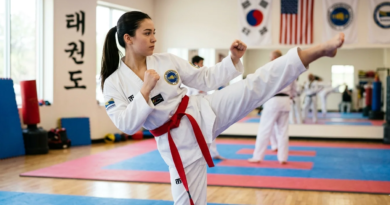
Taekwondo White Belt: What Every Beginner Needs to Know
When you first get a Taekwondo White Belt on your waist, something changes. The material is nearly too plain a one: plain, undecorated, without any of the drama of the black belt that hung on the wall across the dojo. But that is the simplicity of it. The white belt of Taekwondo is a symbol of purity, open-mindedness, and the start of a path that will change the way you move, think, and present yourself in the world.
Be it an adolescent as you enter your first classroom or an adult as you finally give that long-standing curiosity the green light, what the white belt is and what the white belt expects of you will be the tone that sets the rest of it all.
What the White Belt Actually Represents
In Korean martial arts culture, belt colors carry deep symbolic weight. The white belt specifically represents innocence and the absence of prior knowledge. You’re not behind—you’re unburdened. There’s a famous Zen concept called “shoshin,” or beginner’s mind, and Taekwondo white belt training is essentially a physical practice of exactly that philosophy.
This is worth sitting with. Many beginners feel embarrassed wearing white, while more advanced students move with apparent ease around them. Flip that script entirely. You have something those students no longer do: you see the art with completely fresh eyes. Every kick is a revelation. Every stance is a puzzle worth solving.

Core Skills You’ll Learn as a White Belt
White belt curriculum varies slightly by school, but most World Taekwondo Federation and ITF programs cover a consistent foundation. Here’s what you can expect to be learning and drilling in those first weeks:
- Juchoom Seogi—the horse-riding stance, which builds leg strength and foundational balance.
- Ap Koobi—the walking stance, used in nearly every poomsae (form) you’ll ever perform.
- Ap Chagi—the front kick, the most fundamental striking technique in all of taekwondo.
- Arae Makki & Momtong Makki—low block and middle block, your first lines of defense.
- Chigi—basic hand strikes, including the hammer fist and straight punch.
- Taegeuk Il Jang—the first official poomsae (pattern) you’ll learn, built entirely from moves in the list above.
Don’t rush any of these. The white belt is the one time in your Taekwondo life when getting basics wrong is completely acceptable, as long as you keep correcting.
Pro tip
Film yourself doing your kicks at home once a week. Most beginners discover their technique in the mirror looks very different from how it feels. Video feedback is one of the fastest ways to close that gap—and your future self will thank you for the record of how far you’ve come.
The Mindset Gap That Most White Belts Miss
Here’s something most beginner guides won’t tell you: the biggest obstacle for white belts isn’t physical. It’s the ego.
Adults especially struggle here. You might be a surgeon, a senior manager, or someone who has mastered something else entirely—and suddenly you’re being outperformed by a twelve-year-old in a Yellow Belt. That stings. But Taekwondo is built to humble you precisely because humility is what makes growth possible.
Habits that accelerate white belt progress
- Bow with intention. The bows before and after class aren’t a formality—they’re a mental cue to leave your outside identity at the door.
- Ask the dumbest questions. Senior students and instructors expect white belt confusion. Use it.
- Train three days a week minimum. One class a week keeps you static. Two maintain. Three is where you genuinely improve.
- Practice stances during dead time. Horse stance while brushing teeth. Walking stance down the hallway. Sound ridiculous? Blue Belts do this.
- Read about the philosophy. Even light reading on Taekwondo history and Korean culture deepens your connection to what you’re doing.
A Note on Grading: When Are You Ready to Move On?
Most schools test white belts for their yellow stripe or yellow belt somewhere between six weeks and three months into training. The specific requirements differ by organization, but a typical white belt grading will assess:
| Category | Requirements & Details |
| Pattern | Taegeuk Il Jang: Represents Keon (Heaven/Light). Focus on crisp 90-degree turns and distinct heights for high, middle, and low strikes. |
| Theory | Understanding the meaning of the pattern, the significance of the White Belt (purity/innocence), and the basics of Taekwondo history. |
| Korean Terminology | Knowing commands like Charyeot (Attention) and Kyong-ye (Bow), and names for basic blocks like Araemaki (Low block) or Momtongmaki (Middle block). |
| Etiquette | Showing respect to the flags, the master, and fellow students. This includes the proper way to tie your belt and fold your uniform (Dobok). |
| Dojo Conduct | Maintaining silence while others are practicing the “Tenets of Taekwondo” (Courtesy, Integrity, Perseverance, Self-Control, and Indomitable Spirit). |
| Fitness | Demonstrating the stamina to complete the grading without losing form. This includes core stability and leg strength. |
| Basic Conditioning | Flexibility (reaching for toes), push-ups, and the ability to hold basic stances (Sogi) without wobbling. |
Pro tip
In the two weeks before grading, slow everything down by 30%. Perfect, deliberate slow reps embed muscle memory far more deeply than rushed full-speed practice. Speed is the reward for correctness—not the path to it.
Staying Motivated Through the Beginner Phase
The white belt phase tests patience more than athleticism. Progress can feel invisible from inside it. Here’s how to keep your head in the game:
- Set process goals, not outcome goals. “Attend 12 classes this month” beats “get my yellow belt by March.”
- Find a training partner at the same level. Shared struggle is enormously motivating.
- Watch elite Taekwondo sparring on video. Let it inspire you, not intimidate you.
- Track your attendance on paper. Something as simple as a checkmark calendar works surprisingly well.
The students who reach black belt aren’t necessarily the most naturally gifted. They’re the ones who showed up consistently through every awkward, frustrating, “am I actually improving?” week of white and yellow and green.
Frequently Asked Questions
Q1: What is the meaning of “white belt” in Taekwondo?
A white belt represents a blank slate—the beginning of a student’s Taekwondo journey. It symbolizes innocence and the absence of any prior knowledge, marking the point where a student is open and ready to learn.
Q2: What is the time period between white belt and yellow belt?
For most schools, the white belt is assessed for the yellow belt between 6 and 3 months into training, depending on attendance and how regularly the skills required for the yellow belt are displayed.
Q3: In actual Taekwondo competition, do white belts compete against each other?
Sparring is generally introduced at white belt level, in a light and controlled fashion to help students become comfortable with distance and timing, but may proceed to full contact sparring at higher belt levels once basic stances and blocks are mastered.
Q4: Taegeuk Il Jang is what?
Taegeuk Il Jang is the first official poomsae (pattern) in World Taekwondo and is taught to white belt students. It teaches basic stances, blocks, and strikes, which are the foundation of all patterns to follow.
Q5: What are the things that a white belt should concentrate on the most?
When starting, the most important thing for new students to focus on is the proper stance, basic blocks and kicks, and regular attendance—as long as these fundamentals are correct, all later levels will be easier.