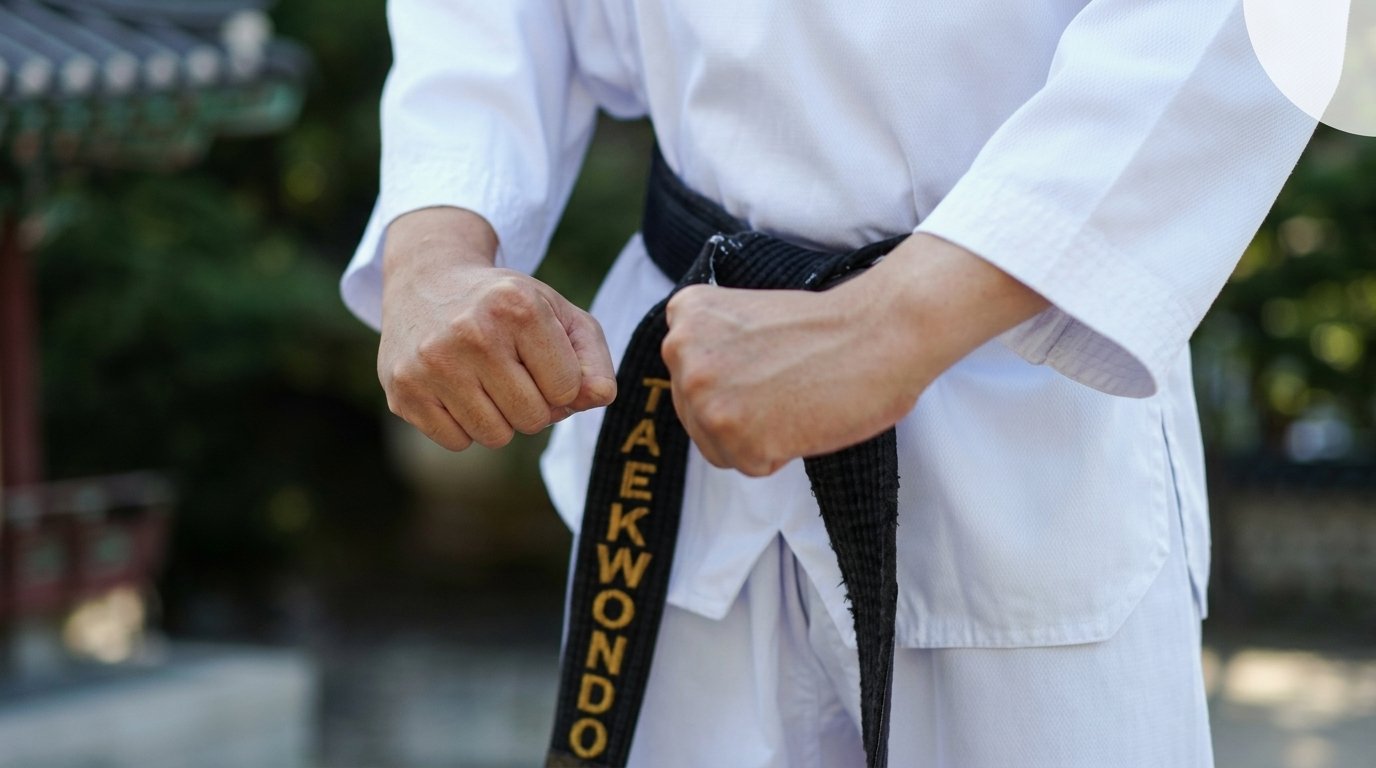
How Long Does It Take to Get a Black Belt in Taekwondo? | Dan Ranks Explained
Most people give up on taekwondo in six months. This is not because taekwondo is too hard for them. The reason is that nobody explained to them what taekwondo is really about.
Taekwondo Black Belt is not the end goal. It is like a new beginning. What you get from having a belt in taekwondo has nothing to do with kicking very high or breaking lots of boards. It is about the kind of person you become when you are training for taekwondo.
If you are someone who plays sports and wants to be the best, or if you are a teacher who wants to be more disciplined, or if you are someone who never gives up, then you should know what it really takes to get a belt in taekwondo. When you understand what taekwondo is really about, it will change the way you train for taekwondo, the way you think about taekwondo and the way you do taekwondo every day.
What a Black Belt in Taekwondo Actually Means
The fact is that it takes time to get a black belt in taekwondo. It usually takes people 3 to 5 years of training every day to get a Black Belt taekwondo. Some people take longer than that. Some people are really focused and they get their black belt faster. The thing is, it does not matter how long it takes.
World Taekwondo says there are nine levels of black belt taekwondo rank and they are called “dans.” When you get your black belt, which is called a 1st dan, it means you are really good at taekwondo, but you still have a lot to learn. Getting a black belt in taekwondo is not like getting a prize; it is like getting a special key that helps you learn even more about taekwondo. It helps you learn things you did not know before you earned your black belt in Taekwondo.
The Belt Ranking System at a Glance
Before reaching black, students progress through a series of colored belts:
- White Belt—beginner, clean slate
- Yellow Belt / Gold—foundational techniques taking root
- Green Belt—growth, skills visibly developing
- Blue Belt sky’s the limit; depth of training expands
- Red Belt—danger and control, power being refined
- Black Belt—integration of all previous belts; the journey deepens
Each color isn’t just symbolic. Each rank requires passing specific technical tests, demonstrating poomsae (forms), sparring, and often written or philosophical components. You earn every stripe.
Pro Tip: Don’t obsess over the belt color. Obsess over your technique. Students who focus on mastery — not rank — consistently test better and retain skills longer.
The Physical Demands Nobody Prepares You For
Let’s be honest about the body. Black Belt Taekwondo training will test you physically in ways that recreational fitness never does.
You will fall. You will get kicked hard. Your shins will bruise. Stretching will make your hips cry. Your lungs will burn through the last thirty seconds of every sparring round. That discomfort isn’t failure. That’s the forge.

Strength, Speed, and Flexibility: All Three, Simultaneously
Most martial arts emphasize one or two physical qualities. Taekwondo demands all three at once. The signature high kicks, dollyo chagi (roundhouse), dwi chagi (back kick), and narae chagi (double kick) require
- Hip flexibility develops over months, not days
- Explosive leg strength to generate power without telegraphing the strike
- Balance and core stability to land cleanly and reset immediately
- Cardiovascular endurance to sustain technique when fatigue sets in
This combination separates taekwondo from casual exercise. You’re not just getting fit. You’re building a specific, athletic intelligence in your body.
The Role of Poomsae (Forms) in Physical Development
Many beginners underestimate poomsae. They see it as choreography, pretty patterns for testing day. Wrong.
Poomsae is where technique gets burned into muscle memory. Each form sequences attacks, defenses, transitions, and stances in a specific flow. Practicing them hundreds of times builds the kind of precision that shows up automatically under pressure—in sparring, in competition, and in life.
Common Mistake to Avoid: Rushing through poomsae to get back to sparring. Students who skip work plateau quickly. Their sparring looks athletic but sloppy. The ones who fill out forms with intention? Their movement has an unmistakable sharpness.
Every serious Black Belt candidate hits a wall, usually around the intermediate belts. Progress slows. Techniques that felt sharp start feeling mechanical. Motivation dips. This isn’t a sign that something’s wrong. This is exactly where the real training begins.
Taekwondo’s philosophical foundation comes from the Five Tenets: courtesy, integrity, perseverance, self-control, and indomitable spirit. These aren’t decorative words framed on a dojang’s wall. They’re behavioral contracts you renew every time you step on the mat.
How the Dojang Builds Unshakeable Focus
Inside the training hall, distraction is not an option. Your instructor calls a combination, and you execute it. A sparring partner throws an unexpected kick; you respond, not react, to it. That gap between stimulus and response is where mental discipline lives.
Teachers say they feel really different after training. Imagine standing in front of a class. It doesn’t bother you as much if you’ve taken a strong kick and had to calm down quickly.
For someone who works hard, stays late, and wants to do their best, taekwondo gives them something a way to struggle in a controlled way. It shows that being tired and being great are not mutually exclusive. They actually go together.
Perseverance as a Practiced Skill
Most people think you either have perseverance or you don’t. My experience with taekwondo shows that’s not true.
Every time I take a grading test, lose a sparring match, or struggle to land a technique. After practicing it hundreds of times. I am building my resilience. I am learning how to fail.
Here’s a tip: Keep a brief training journal. After each session, write down one thing you did badly. One thing you did well. Over time you’ll notice patterns. Seeing your progress written down in your own words can be really motivating. It’s more meaningful than any highlight reel.
What Most People Get Wrong About the Black Belt
Here’s the misconception that derails more students than any physical limitation ever could: they believe the black belt is a destination.
Walk into any serious dojang and ask a 3rd or 4th dan instructor what earning their first black belt felt like. Almost universally, they’ll describe it as humbling, not triumphant. Because at that moment, for the first time, they could clearly see how much they didn’t know.
The belt does not say you are a master. It says you are ready to learn more about the taekwondo belt and get better at it.
This is very important for people who like to get grades, for athletes who like to win, and for people who like to finish things. The taekwondo black belt journey will change the way you think. That is a good thing for you. You do not finish the taekwondo black belt journey. You keep learning and growing with the taekwondo belt.
Another widespread myth: that black belts are built in dojangs alone. They aren’t. The student who meditates, sleeps well, studies philosophy, and applies tenet-based thinking at work and at home progresses faster and more completely than the one who only shows up to kick things twice a week.
Earning It: A Realistic Roadmap
You don’t need exceptional talent. You need exceptional consistency. Here’s what a realistic path looks like:
- Months 1–6: Build foundations—stances, basic kicks, first poomsae, white to yellow belt
- Months 7–18: Accelerate technique—combinations, sparring introduction, green to blue belt
- Months 19–36: Pressure-test everything—advanced poomsae, competition exposure, red belt
- Months 37–60: Refine and integrate—pre-black grading, assistant instruction, 1st dan test
Notice there’s no shortcut listed. That’s intentional. The road is the reward.
Common Mistake to Avoid: Comparing your timeline to another student’s. Bodies are different. Schedules are different. Life is different. The only race in taekwondo is the one between who you are today and who you’re capable of becoming.
The Black Belt Is a Beginning, Not a Bow
Strip away the ceremony, the board-breaking, and the formal bowing, and what you have is a person who chose difficulty repeatedly over a period of years and kept showing up anyway.
That person carries something the belt merely symbolizes. Sharpness. Stillness under pressure. The quiet confidence of someone who has been knocked down and chose to stand up, not because it was easy, but because standing up became their default setting.
Athletes find their edge sharpened. Teachers find their patience deepened. Workers find their persistence reinforced. Learners find that the dojang is, perhaps, the most honest classroom they’ve ever entered.
The black belt doesn’t change what you do. It changes how you do everything.
Now it’s your turn: Are you currently training in taekwondo, or have you earned your black belt already? What was the hardest part of the journey, the physical grind, the mental plateaus, or something else entirely? Drop your experience in the comments. Someone reading this right now needs to hear exactly what you went through.
FAQs
Q1: What is the time period of the black belt in taekwondo?
The first degree black belt is achieved after three to five years of regular training, depending on the frequency of training and the requirements of the school.
Q2: How many dan ranks does it take to be a black belt in Taekwondo?
There are nine dan grades in World Taekwondo, ranging from entry-level black belt 1st dan to 9th dan (usually given to grandmasters who have made a significant contribution to Taekwondo for decades).
Q3: Does getting a black belt indicate that you have mastered the art of Taekwondo?
No. Most teachers will say that a black belt is not the end goal; it’s the start of real training. A 1st dan black belt is not an indicator of mastery; rather, it is a good foundation.
Q4: What do you do after 1st dan black belt?
Black belts study and train to achieve further Dan grades; they may also start teaching; they might be practising more complex Poomsae and developing their technical and philosophical skills of the martial art.
Q5: Is a black belt in Taekwondo hard to get?
Yes, both physically and mentally. It takes many years of regular and careful training, technical ability in all forms, sparring, and breaking, and the ability to persevere through plateaus and setbacks.
Q6: How old must one be to get a black belt in Taekwondo?
Most World Taekwondo-affiliated schools will require students to be 15 years old to receive a full black belt, whereas it is possible for students to receive a “poom” (junior black belt) at a younger age that will convert to a full black belt at 15.